


If you are comparing a Bluetooth vs mesh motorcycle intercom, the question that decides it is how many riders need to talk and how spread out they get on the road. The two technologies connect helmets in different ways, and each suits a different kind of ride. This guide explains the difference in plain terms, then gives a clear pick for riding two-up, riding with a few friends, and riding in a big group.
When I started riding more than 28 years ago, Bluetooth and mesh intercom systems weren’t part of motorcycling. We relied on hand signals and line of sight to communicate. That worked reasonably well in smaller groups, but larger rides were more challenging. Add poor weather or winding roads, and keeping everyone informed became even more difficult.
For a wider look at what helmet communication can do, the site already covers it in the motorcycle Bluetooth communication guide. This piece is only about choosing between the two connection types.
How Bluetooth intercoms connect riders, and where that design runs out
A Bluetooth intercom links helmet units directly to each other. You pair your unit with another rider’s unit, much as you would pair a phone with a speaker, and the two of you can talk. The same Bluetooth connection is also how the unit talks to your phone for calls, music and navigation audio.
Adding riders to a Bluetooth intercom conversation can become more complicated as the group grows. Some systems use linked connections between riders, while others support different group configurations. The number of supported riders, connection stability, and ability to reconnect depend on the specific model. Most Bluetooth intercoms are designed for a small number of riders, and the exact limit differs from model to model, so check the product’s stated rider count before you buy.
Bluetooth intercom systems have three main limitations:
- Rider count. Past the model’s limit, extra riders simply cannot join.
- Distance between riders. Manufacturers typically advertise communication range under ideal, open conditions. Hills, buildings, terrain, obstacles, and interference can reduce effective range. Wind noise can also make conversations difficult, even when the radio connection remains strong.
- Chain dependence. If the rider in the middle of a linked group drops back, riders on the far side of that link can lose contact with each other, depending on how the group is set up.
None of this makes Bluetooth a poor choice. A system built for two or three riders does that job well. Trouble starts when you ask it to behave like a larger network.
How mesh networks connect riders, and what changes when someone drops back or joins
Mesh intercom systems create a network that allows compatible units to communicate and, depending on the system, relay signals between riders. Unlike traditional Bluetooth pairing arrangements, mesh networks are designed to manage changing group positions and reconnect riders automatically when they return within range. Instead of each helmet connecting only to one neighbor, the units form a shared network. When compatible riders are positioned within effective relay range, mesh systems can extend communication across a larger group. Actual coverage depends on terrain, rider spacing, interference, and the manufacturer’s network design.
That relaying changes what happens when the group stretches out or changes shape. When someone falls behind at a light, the network adjusts around the gap, and when they catch up, their unit rejoins without anyone re-pairing anything. Riders can also join an open group channel and leave it again, which suits rides where people arrive and depart along the way.
Mesh communication systems are not necessarily compatible across manufacturers. For example, Sena uses its Mesh Intercom technology, while Cardo Systems uses Dynamic Mesh Communication (DMC). Both manufacturers provide technical documentation explaining how their systems operate and which devices are compatible. Riders should consult these specifications before choosing a system for group communication.
Mesh has trade-offs of its own:
- Price. Mesh units typically cost more than basic Bluetooth intercoms, although premium Bluetooth models can be more expensive than entry-level mesh units. Compare current prices and features before deciding.
- Brand lock-in. Mesh systems are generally proprietary. A mesh unit from one maker usually talks only to units of the same system.
- Power use. Running a relay radio all day can draw more from the battery than a simple Bluetooth link, so look at the rated talk time.
Rider and passenger: why a simple Bluetooth pair is often all you need
With one rider and one passenger, the system only has to connect two helmets a few feet apart. That is the easiest job in helmet communication, and a Bluetooth pair handles it without strain. Range, chain dependence and rider limits do not matter when the two units are always sitting together.

Spending on mesh for a two-up setup buys capability you will not use in that role. A pair of Bluetooth units, or a dual pack sold for this purpose, covers the conversation, the shared GPS prompts and the music. The money saved is better spent on audio quality and a comfortable fit for the passenger’s helmet.
Things that matter more for two-up riding:
- Passenger controls. The passenger should be able to adjust volume and answer an intercom call without reaching over the rider’s shoulder or fumbling with large gloves.
- Microphone type. Wind noise can make conversations difficult at highway speeds. A wired microphone typically works well in full-face helmets, while a boom microphone is commonly used in open-face and modular helmets. Check the manufacturer’s recommendations for your helmet style.
- Battery for long days. Two-up touring means long hours. Choose units with a rated talk time that covers your longest riding day, or that can charge while you ride.
One exception: if you often ride two-up in a larger group and want your passenger in the group conversation as well, the group question below applies to you.
Small groups of riders: where Bluetooth still works and where mesh starts to earn its price
For three or four riders, Bluetooth can still work, with some conditions. If the same friends ride together regularly, keep a fairly tight formation, and have all bought compatible units, a Bluetooth group connection does the job. The setup is a one-time pairing, and the units are usually cheaper than mesh.
Bluetooth starts to strain when the group has any of these traits:
- Riders spread out on twisty roads, where the rider at the front and the rider at the back are well beyond the range of a single link.
- Members who join or leave partway through the ride.
- A group that has to work across different brands because friends already own different units.
- A group that frequently loses connections when riders spread out or change positions.
If two or more of those describe your rides, mesh begins to earn its higher price. The network relays the signal along the line, and a rider who drops back reconnects automatically. For a small group that rides together only occasionally, Bluetooth is the reasonable pick. For a group that rides every weekend on open, winding roads, mesh removes a lot of the reconnecting that Bluetooth requires.
The brand issue deserves a decision before anyone buys. Whichever type the group picks, it is simplest if everyone buys the same system. Many Bluetooth units can connect across brands through a universal pairing mode, but this often limits the number of riders, and audio quality can suffer. Check the maker’s compatibility notes first.
Large groups and club rides: why mesh is the better fit
Large groups are where Bluetooth stops being a practical choice. A club ride can include a dozen or more bikes, strung out over a long stretch of road, with riders joining at one stop and leaving at another. A chained Bluetooth setup cannot hold that many riders in one conversation, and any gap in the chain splits the group.
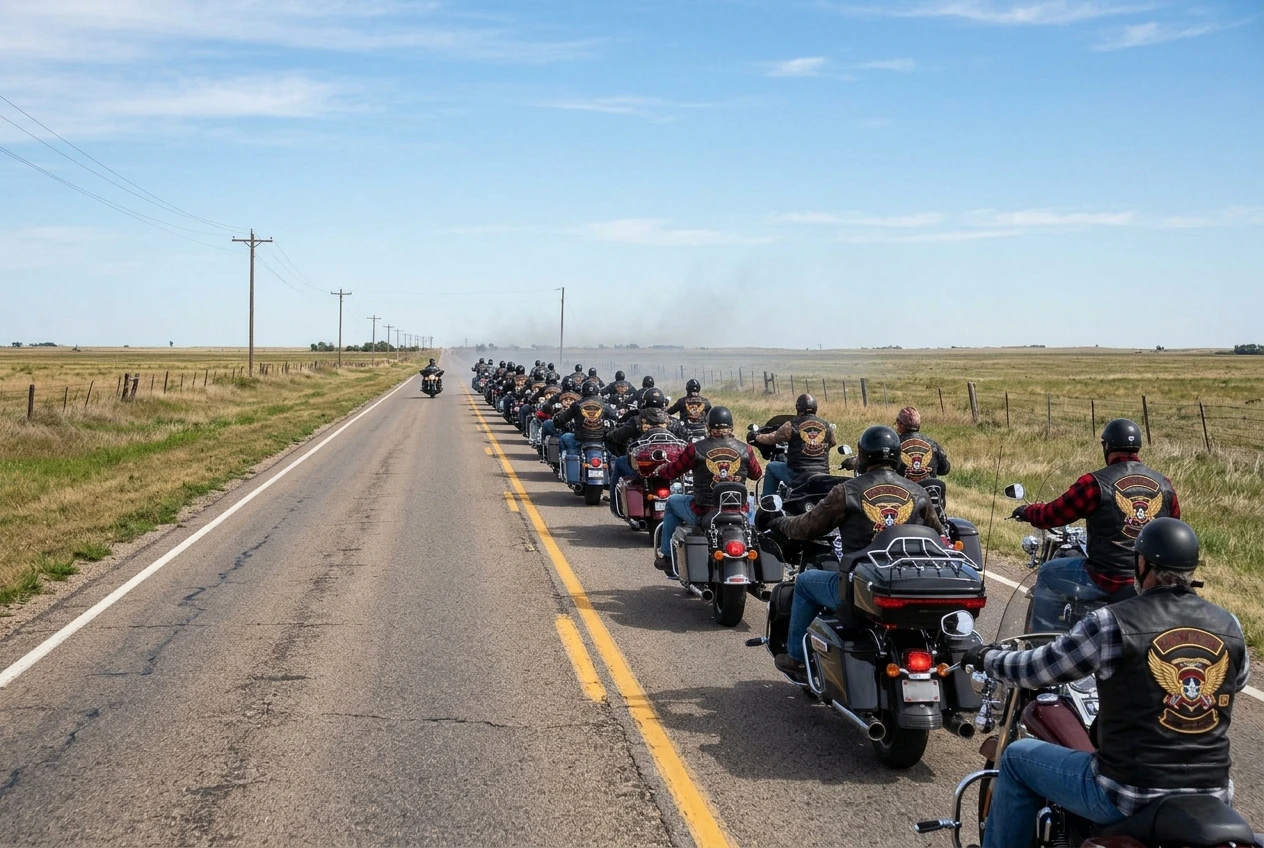
Mesh was built for this situation. Mesh systems can extend communication across a larger group when riders remain within effective relay range. Their ability to reconnect riders also makes them particularly useful for club rides where group positions frequently change. A road captain at the front can give directions, and a sweep rider at the back can report a problem, without either one needing a direct connection to the other.
For club rides, check these points before you commit:
- The stated rider capacity of the mesh system, and whether that holds in real use.
- Whether the club will standardize on one brand. Mesh works best when everyone owns the same system, so it helps to agree on one before members buy.
- Whether a separate small channel is available. Some systems let a rider and passenger, or a pair of friends, talk privately while staying in the group.
The cost multiplies across a club, but a club that agrees on a system usually finds that the improved communication on the road is the reason people buy in.
Everything else that affects the choice: phone calls, music, GPS prompts, battery life, helmet fit and mixing brands
Connection type is the biggest factor, but several other points shape which unit suits you.
Phone calls and music. Both Bluetooth and mesh units connect to a phone through Bluetooth, so calls and music work on either type. What differs is how a unit handles interruptions: whether a phone call pauses the intercom, whether music keeps playing quietly under conversation, and how the unit treats a navigation prompt. Read the product description for how it ranks those audio sources.
GPS prompts. Turn-by-turn directions arrive as audio from the phone or a dedicated GPS unit. On a group ride, check whether prompts are heard only by the rider who has the GPS or can be shared. The site’s motorcycle electronics guide for communication, GPS and cameras covers navigation gear in more depth.
Battery life. Compare the rated talk time against your longest riding day, and check how the unit charges. Mesh units tend to use more power, and a unit that can be charged on the go, or that has a quick top-up, saves a flat battery on a long tour.

Helmet fit. The speakers sit against your ears and the body of the unit clips or mounts to the side of the shell. Some helmets have very little room between the shell and the ear pocket, and a thick speaker can press uncomfortably. Check whether your helmet maker lists a compatible communicator, and whether the unit suits a modular, full-face or open-face shell. If you are also shopping for a new lid, see the highest rated motorcycle helmets page.
Mixing brands. Mesh systems generally speak only to their own kind. Bluetooth units can often pair across brands, but the connection is usually limited to a pair of riders. Plan for one brand per group wherever you can.
Quick decision chart: match your riding setup to a system type
Your riding setup Best fit Why Rider and passenger, always together Bluetooth pair The helmets stay close, so range and rider limits do not matter Three or four riders, tight formation, same friends each time Bluetooth group Lower cost, and the group rarely spreads out Small group on winding roads or with changing members Mesh Relaying and automatic rejoining cut down on reconnecting Large group or club ride Mesh Supports larger groups and keeps working when riders drop back Group that already owns mixed brands Bluetooth, with a universal pairing check Mesh rarely works across brands Rider who mostly rides alone and wants calls, music and GPS Single Bluetooth unit No group features needed
If your setup falls between two rows, think about your worst ride rather than your average one. A system that copes with the most spread-out, most crowded ride you do will serve you better than one that only suits the easy days.
Questions riders ask before buying
Can I use a Bluetooth intercom and a mesh intercom together?
Bluetooth and mesh intercoms generally use different group communication methods, but some manufacturers offer features that allow Bluetooth-connected riders to participate in mesh conversations through a compatible device. These capabilities vary by model and brand, so check the manufacturer’s specifications before purchasing.
Is mesh always better than Bluetooth?
No. Mesh suits larger and more spread-out groups. For a rider and passenger, Bluetooth does the same job at a lower cost, with less to configure.
How far apart can riders be?
Every maker publishes a range figure, but it applies to open conditions. Hills, buildings, terrain, obstacles, interference, and the distance between riders can reduce effective communication range. Wind noise can also make conversations harder to understand, even when the radio connection remains strong. For mesh, the group’s total reach also depends on how many riders are in the network, since each unit relays the signal.
Do these units work with any helmet?
Most mount on the outside of the shell with a clip or adhesive plate, and the speakers go inside the helmet. Fit depends on the helmet’s interior space and shape, so check compatibility before buying.
Will the intercom still work if my phone is not connected?
Intercom conversation between units does not depend on a phone connection. The phone is needed only for calls, music and phone-based navigation audio.
What should I buy first if my group is still deciding?
Agree on one brand and one type before anyone purchases. A group using compatible communication systems will generally have fewer connection problems than one using a mixture of incompatible devices.
The best motorcycle intercom isn’t necessarily the most expensive or the one with the longest advertised range. It’s the system that reliably supports the riders you communicate with most often. Before purchasing, compare manufacturer specifications, helmet compatibility, and the communication systems already used by your riding group.