

If you are comparing a Sena vs Cardo motorcycle communication system, the specs matter less than three facts about your riding: how many people you ride with, what they already own, and how long and loud your typical ride is. A system that is excellent for a two-person touring bike can be a poor fit for a solo commuter on a naked bike, and the reverse is also true.
This comparison covers Sena (Bluetooth models and Sena Mesh, including the 50S and 50R) and Cardo (Dynamic Mesh Communication, or DMC, in the Packtalk line, plus the Bluetooth-focused Spirit line). It matches each brand to four situations: solo commuting, riding as a couple, small-group weekend rides, and large club rides.
Specifications change with every product refresh, so treat the figures here as typical and confirm the current numbers on the product page before you buy.
Who this comparison is for, and the three questions that decide it
This is for riders of any bike type, cruiser, sport, adventure, or touring, who want to talk to a passenger or other riders, take calls, hear navigation prompts, or play music inside the helmet. If you only want music and the occasional phone call, you are shopping for a simpler product than someone leading a group of ten bikes.
Answer these three questions first:
- How many people will you talk to at once? One passenger or one riding partner points to Bluetooth. Three or more riders usually points to mesh.
- What do your riding partners already use? Sena and Cardo offer cross-brand Bluetooth intercom compatibility on certain models, although pairing methods and available features vary. Cross-brand connections may not support the full mesh communication capabilities available within each manufacturer’s system. If most of your riding partners use one brand, choosing that same brand will generally simplify group communication.
- What are your ride conditions? Long highway days at speed, open-face helmets, and loud exhaust all raise the bar for microphones and speakers, and they raise the cost of getting it wrong.
How Sena and Cardo connect: Bluetooth, mesh, and each brand’s own technology names
Both brands use standard Bluetooth technology to connect to your phone, and both use Bluetooth for rider-to-rider communication. Bluetooth technology is developed and maintained by the Bluetooth Special Interest Group (Bluetooth SIG), the organization responsible for Bluetooth standards.
Bluetooth intercom works well between two riders who are fairly close together. It generally becomes less practical as you add riders because additional connections can require more setup and management.
Mesh networking is where the brands use their own names and approaches.

- Sena Mesh is used on the 50S and 50R, among other models. Riders can typically join an open mesh, where anyone nearby on the same channel can talk, or a private mesh, which limits the group to people you invite. Riders can usually drop out and rejoin without anyone re-pairing, which is useful when a group gets split by traffic.
- Cardo Dynamic Mesh Communication (DMC) is used on Packtalk models such as the Packtalk Edge and Packtalk Bold. Cardo typically advertises DMC groups in the range of about fifteen riders, and the system is designed so that the network re-forms itself when riders move out of range and back in. Check the current listed group size for the model you are considering.
- Cardo Spirit and similar entry models are mainly Bluetooth products. They typically cover phone, music, and a rider-to-rider intercom without the mesh feature.
On paper the two mesh systems are close. The practical differences usually show up in group management, how each app handles it, and how many riders your group actually has. If you want the underlying explanation of when Bluetooth is enough and when mesh earns its price, the existing guide on Bluetooth vs mesh motorcycle intercoms covers it in more depth.
For additional technical information about these communication technologies, visit the official Sena and Cardo Systems websites. Both manufacturers provide model specifications, compatibility information, and product documentation.
Sound quality and noise handling: Sena’s and Cardo’s speakers and microphones in real riding conditions
Both brands partner with audio companies for their premium speakers. Sena’s 50S and 50R have typically been marketed with Harman Kardon speakers, and Cardo’s Packtalk line has typically been marketed with JBL speakers. Both claim wide frequency range and loud maximum volume, and both generally sound good at city speeds.
Speaker quality matters less than the way you wear the helmet. Foam padding that holds the speaker too far from your ear will lose bass and clarity no matter which brand you buy. Many riders find that a small amount of padding adjustment does more than a model upgrade.
Wind noise is the real test, and it is the one area where specifications tell you little.
- Microphones: Both manufacturers offer noise-cancelling microphones, with boom microphones generally intended for open-face or modular helmets and wired microphones commonly used in full-face helmets. Communication clarity depends heavily on correct microphone placement, helmet design, and wind protection rather than microphone style alone.
- Automatic volume adjustment is common on both. It raises the volume as noise rises, which helps, though at high speed you may still turn it up manually.
- Earplugs are worth considering whichever system you choose. Many riders use them to protect hearing, and the speakers can then run at a lower volume, which generally improves clarity.
Neither brand reliably wins on sound for every helmet and rider. If you can, try the same helmet with both systems, or check return terms so that you can swap if the audio disappoints. That point is covered in the last section.
Controls, apps, and ease of use with gloves on
Gloves are the practical constraint. A control you can find by feel at 60 mph is worth more than a feature list. Over my years of riding, I’ve learned that equipment needs to be easy to operate without distracting you from the road. That becomes particularly important when you’re wearing heavy gloves, riding in cold weather, or dealing with strong crosswinds. A communication system may have impressive features, but if the controls are difficult to operate with gloves on, those features become less useful.

Sena’s 50S uses a jog dial; the 50R uses a button-based interface. Cardo’s Packtalk models typically use a large jog dial plus buttons, which many riders find easy to operate with thick winter gloves. In general, jog dials and large buttons hold up better than touch panels in thick gloves or wet weather.
Voice control is the backup. Both brands offer voice commands, and Cardo has typically offered a “Natural Voice Operation” system that responds to spoken commands without a button press. Sena’s voice commands generally work but may need a specific phrase. Both can struggle at speed with wind noise, so learn the physical controls too.
On the app side:
- Sena typically uses the Sena Motorcycles app for everyday settings and group setup, and a separate Sena utility program for firmware updates and deeper configuration.
- Cardo typically uses the Cardo Connect app for settings, intercom groups, and firmware updates.
Both apps usually let you adjust equalizer settings, set up mesh groups, and update firmware over the air or by USB (depends on model and update method). Riders often report that app quality changes from one release to the next, so read recent user reviews of the app itself, not just the hardware.
Battery life, charging, and what to expect on long touring days
Rated talk time is typically given in hours, and the number is usually measured under favorable conditions. Mesh mode, high volume, and cold weather generally shorten it. Plan on getting less than the label says, especially if you run mesh all day with music or GPS audio on top.
A few things to check before you buy:
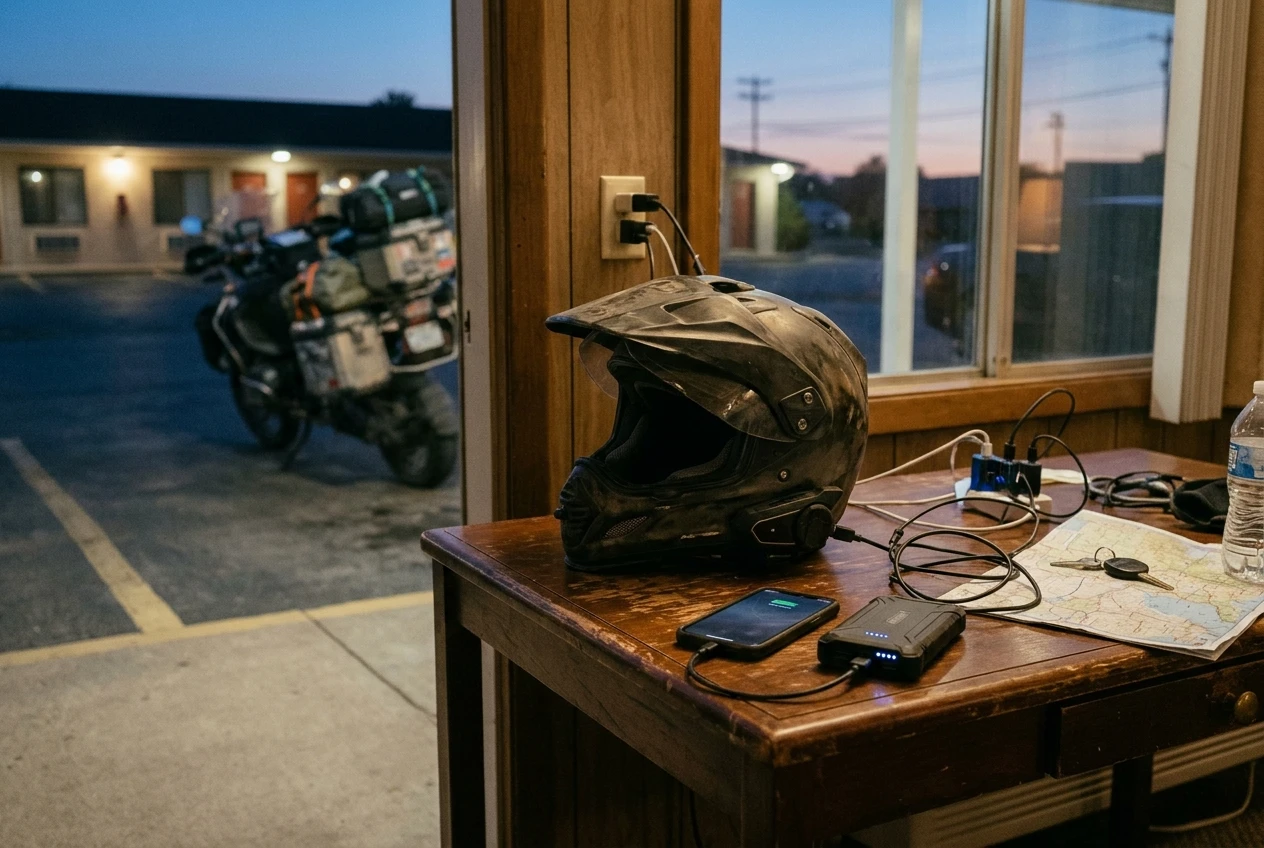
- Charging port. Newer models from both brands generally use USB-C, which means one cable can charge your intercom, phone, and other devices.
- Charging while riding. Many riders on long days run a USB power bank or a bike outlet to top up. Confirm that the model you are considering keeps working while it charges.
- Fast charging. Both brands have typically offered a quick-charge feature that provides some hours of use from a short charge. Check the current figures if a lunch-stop top-up is part of your plan.
- Standby behavior. Some units drain faster than others when left on overnight, so check the owner’s manual and remember to power the unit off at the end of the day.
For multi-day touring, the main habit is simple: charge the unit every night with the rest of your devices, and carry a short USB-C cable.
Best picks by rider type: solo commuter, two-up couple, small group, and big club rides
Rider type | Typically suits | Sena option | Cardo option |
|---|---|---|---|
Solo commuter | Bluetooth for calls, music and navigation | Bluetooth-focused Sena models | Spirit line |
Two-up couple | Stable Bluetooth intercom between two helmets | Matched pair from Sena’s lineup | Packtalk or Spirit pair |
Small group (3 to 6 riders) | Mesh | Sena Mesh (50S, 50R) | Packtalk with DMC |
Large club rides | Mesh with a high rider limit | Sena open mesh | Packtalk with DMC |
These recommendations are general starting points rather than product rankings. Bluetooth is usually sufficient for two riders, while mesh becomes more useful for larger groups. Supported group sizes, compatibility, and available features vary by model.
Solo commuter. You mostly need phone calls, navigation prompts, and music. A Bluetooth-focused model such as Cardo’s Spirit line or one of Sena’s Bluetooth-only models usually does the job at a lower price than a mesh unit. Prioritize a low-profile design, easy controls, and a microphone that holds up at commuter speeds.
Two-up couple. The key feature is a reliable rider-to-passenger connection that stays stable for hours. Bluetooth intercom generally works well here, since only two helmets are involved. Many couples buy a matched pair, either from the Cardo Packtalk line or Sena’s lineup, because one box often costs less than two separate units. Check whether the passenger’s helmet suits the mounting style.
Small-group weekend rides (three to six riders). This is where mesh begins to pay off. Both Sena Mesh (on the 50S and 50R) and Cardo DMC (on the Packtalk line) are designed for this. The deciding factor is usually the brand your friends already own, because mixing brands generally limits you to a basic Bluetooth connection. If nobody owns anything yet, compare the two apps and pick the one whose group setup makes more sense to you.
Large club rides. Big groups need a system with a high rider limit and an easy way to rejoin after a split. Cardo DMC is typically advertised for around fifteen riders (model-dependent; verify against the specific Packtalk model), and Sena’s open mesh is typically described as having a much higher or no fixed limit, though real-world performance usually depends on spacing and terrain. On club rides, a single open channel for everyone can get noisy, so a private group for the road captain and sweep riders is a common setup. Ask club members which brand most of them run before you decide.
Mounting, helmet fit, and compatibility checks before you buy
Check these before ordering, since they cause more returns than audio quality does:

- Helmet type. Full-face, modular, open-face, and half helmets each have different mounting needs. Boom microphones suit open-face and half helmets, while wired microphones usually suit full-face and modular styles.
- Speaker space. Look at the ear pockets in your helmet. Thick, low-profile speakers may not fit in a helmet with shallow ear cutouts. Sena’s 50R is typically described as a slimmer design than the 50S, so compare dimensions if space is tight.
- Mounting method. Most units offer a clamp that fits between the shell and the liner, plus an adhesive mount. Clamp mounts are generally easier to move between helmets, while adhesive mounts can sit lower on the shell but are harder to remove.
- Glasses and sunglasses. Thick speakers can press against temple arms. Try the helmet on with your glasses before you commit.
- Helmet warranty. Some helmet manufacturers advise against drilling or adhesive mounts. Read your helmet’s manual, and check whether the manufacturer sells a matched communication system.
- Phone and GPS compatibility. Confirm that your phone, navigation app, or motorcycle GPS unit pairs with the intercom you are considering, and check whether you want one device or several connected at once.
Where to buy and what to confirm about warranty and returns
Buy from an authorized retailer, either the manufacturer directly or a reputable motorcycle gear store. Gray-market listings may not carry a manufacturer warranty, and some cheaper listings turn out to be older models or imports with different firmware or packaging.
Before you order, confirm:
- The warranty length and what it covers, and whether it applies to the seller you are buying from.
- The return window, and whether returns are accepted after you have mounted the unit on a helmet. Some stores accept returns only if the product is unused or in near-new condition.
- Whether the listing is for a single unit or a dual pack, since the price difference between the two is large enough to cause mix-ups.
- The model name and generation on the listing, so that you are not buying a previous version by mistake.
If a retailer offers a 30-day return, it is worth using that window to test the unit on your actual commute or your usual group ride.
Next steps
Start with the Bluetooth vs mesh motorcycle intercom guide if you are still deciding between the two connection types. Once you know which one fits, compare the Sena 50S and 50R against the Cardo Packtalk and Spirit models, choosing the one that matches your riding style.